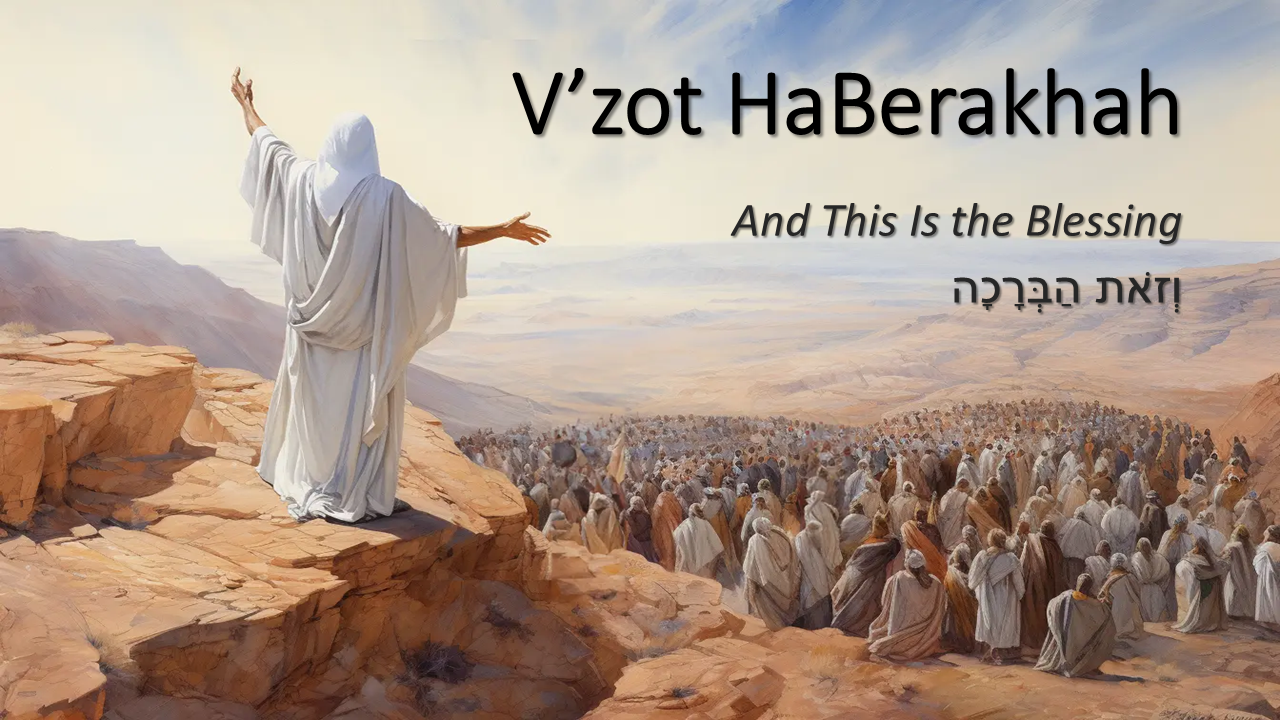
When Moshe our teacher prepared to depart, he lifted his eyes toward the mountains and blessed the tribes of Israel, each according to their inheritance. Yet even as he spoke, his words hinted beyond their immediate fulfillment, toward a time when blessing would weave together Israel and the nations under the reign of Messiah.
Moshe began by recalling how Adonai appeared at Sinai in fire and glory, with myriads of holy ones at His side. The sages say: just as Israel received Torah amidst thunder and flame, so also the nations will see the fullness of Torah revealed through Messiah, the Living Word. For the written Torah given at Sinai finds its completion in the One who embodies it perfectly. To Reuben he said, "May you live and not die." Though diminished, Reuben would endure. In the same way, Messiah gathers the scattered ones whose strength wanes, restoring life to those who seemed forgotten. To Judah, Moshe cried for help and victory. Judah, the lion, would bring forth kingship—yet this line ultimately finds its crown not in David alone, but in the Son of David, Messiah Yeshua. Through Him, Judah’s voice is heard, and dominion extends from Jerusalem to the ends of the earth. Levi was praised for holding fast to covenant and teaching Torah. The Levites tested loyalty even against their own kin. So too Messiah, from the line of Judah yet bearing the priesthood "after the order of Melchizedek," purifies the people and teaches with authority greater than the scribes. Through Him, the priestly calling of Israel to be a light to the nations is renewed. Joseph was blessed with the bounty of heaven above and the deep below. His horns are like the wild ox, pushing the peoples to the ends of the earth. This pictures both the physical fruitfulness of Joseph’s seed and the spiritual fruitfulness of Messiah, the greater Joseph, who went down into the pit and rose again to nourish Israel and the nations with the bread of life.
Each tribe’s blessing points beyond its borders, echoing the greater blessing yet to come. For as Moses gazed from Mount Nebo and saw the land but could not enter, so Israel saw the promise but awaited a greater Joshua—Yeshua—who would indeed lead the faithful across into everlasting inheritance. And when the text declares, "Never again has there arisen a prophet like Moshe, whom the Lord knew face to face," the Spirit whispers: yet there would come One greater still, Messiah Yeshua, who is not only known face to face, but is Himself the very radiance of God’s presence. Moshe was faithful as a servant; Messiah is faithful as a Son. Thus the Torah ends with blessing, and its blessing unfolds fully in Messiah. The last vision of Moshe, beholding the Land, points to the greater vision still—that all the earth shall be filled with the knowledge of the Lord, as the waters cover the sea, in the days of the Son of David who reigns forever.
As we come to the end of the Torah, V’zot HaBerakhah (“And this is the blessing”) closes not only the words of Moshe but also frames the entire story of Israel’s covenant journey. The very last image we have is Moshe standing on Mount Nebo, gazing into the Promised Land that he cannot enter. He blesses the tribes, appoints Joshua, and hands Israel into God’s care. For Messianic believers, this moment is both bittersweet and prophetic. Why? Because it points us to Messiah Yeshua, who brings the ultimate fulfillment of all the blessings Moshe spoke.
The Blessings and Messiah
Reuben: Moshe says, “Let Reuben live and not die.” Reuben had stumbled earlier in Torah history, yet Moshe prays for his restoration. In Messiah, we learn that even when our legacy seems diminished, Yeshua restores us and calls us to life. There is no tribe, no person, no nation too broken to be revived by His redemption.
Judah: For Judah, Moshe prays for strength in battle and victory over enemies. This blessing foreshadows the Lion of the Tribe of Judah, Yeshua Himself. Through Him, victory is not merely over physical enemies but over sin, death, and the adversary. Judah’s strength points toward eternal kingship under Messiah.
Levi: Moshe blesses Levi for faithfulness in guarding the covenant and teaching Torah. Yeshua, though from Judah, takes on the eternal priesthood “after the order of Melchizedek.” He is the great High Priest who mediates for us, making Levi’s calling complete. And through Him, we as believers join in a priestly calling, offering spiritual sacrifices of praise and intercession to the Father.
Joseph: Joseph’s blessing is abundant and expansive. He is described with horns strong enough to push nations to the ends of the earth. This reflects the fruitful, outward-reaching nature of Joseph’s calling. Messiah Yeshua is the greater Joseph, who was rejected, went down into the pit of death, and rose again to provide the true bread of life. Today, His gospel continues to bear fruit to the ends of the earth.
Each blessing to the tribes has its immediate fulfillment in Israel’s history, but in Messiah we see their spiritual completion. These blessings teach us that God’s gifts are not ended at the Jordan. Even as Torah’s narrative ends, God’s promises extend further—fulfilled in Messiah and extended through His people.
Moshe and the Greater Joshua
At the climax of the Torah, Moshe sees the land but cannot enter. His life’s work ends there on Mount Nebo. Yet God raises up Joshua (Yehoshua) to lead Israel into inheritance. For us, this is a prophetic picture. Joshua’s name is the same as Yeshua’s in Hebrew, and just as Joshua led Israel into the Land, so Yeshua leads believers into eternal inheritance and rest.
In other words, the Torah intentionally finishes with anticipation. The journey is not complete without the Messiah; here's how it applies today:
Like Reuben, we may feel diminished by past sins or failures. In Messiah, we are restored to life.
Like Judah, we are called to endure in spiritual battle, trusting that victory is secured in Yeshua.
Like Levi, we are to be teachers of Torah through our lives, showing holiness and compassion as priests in the world.
Like Joseph, we are to be fruitful, carrying the blessing of Messiah outward to the nations.
But perhaps the most important lesson comes from Moshe himself. He saw the promise but did not enter. This teaches us to long for what God has promised, but to trust His timing and His chosen Redeemer. Messiah Yeshua is our ultimate Joshua, and it is only through Him that we inherit the fullness of God’s promises.
The Torah ends with a note of expectation. Deuteronomy says there never again arose a prophet like Moshe, whom Adonai knew face to face. Yet in Yeshua, we see God face to face, for He is the very image of the invisible God. The Torah closes with waiting, but the gospel opens with fulfillment. When we finish the Torah each year, we immediately begin B’reishit again, reminding us that God’s plan is never stopped—it cycles, renews, and points us forward. In the same way, in Messiah, every ending is also a new beginning.